
The Realities of Choosing Quartzite Countertops
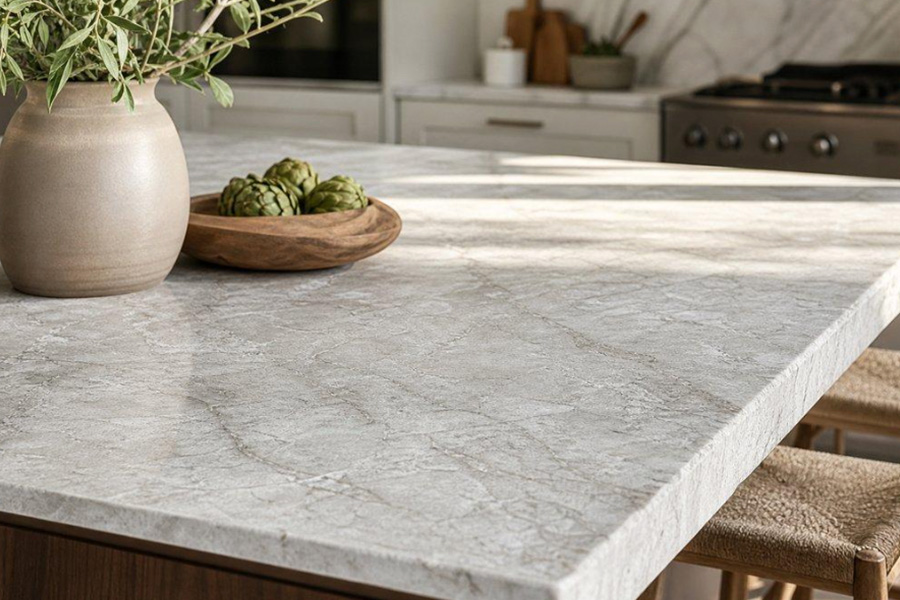
Quartzite kitchen countertops
Quartzite kitchen countertops
Quartzite countertops are dramatic in a beautiful way. Quartzite is a natural stone (it’s not to be confused with engineered quartz), formed under tremendous heat and pressure. The resulting material is hard-wearing and durable, as well as being unique. Quartzite countertops will never look ordinary or mundane.
Here’s what you should know to make a successful quartzite countertop installation happen.
Start with the actual slab
Quartzite has a very crystalline appearance. And, because it’s a natural stone (keep britannica.com/science open if you’re going to need the details), it varies from slab to slab. Some are very subtle, with delicate, marble-esque veining. Others can have more intense veining, mineral deposits, and fissures or pits. You want to ensure that you understand exactly what you are purchasing by viewing the actual slab and not by looking at a small sample. Even if you don’t think you can read a stone slab, it’s important to understand that you are buying something truly unique.
Make sure the cabinets are ready
Quartzite is extremely heavy. This can cause some stress on the cabinetry, particularly if it’s not perfectly level or sturdy. These stress points can lead to uneven seams.
Lifting quartzite is not a DIY job; this needs to be accomplished by a skilled team. Removing your existing countertops is also helpful before the final templating is done, since this allows for adjustments to be made if the walls aren’t level or your cabinets have shifted over the years.
Skip this if there’s no overhang
If you have an overhang for seating, such as a breakfast bar, or if you want to make your countertops appear to float, they will need additional supports or brackets. These are invisible but very important additions, though for standard installations in which countertops meet a wall and sit flush with cabinets, they’re not needed.
Here’s what happens during installation
There are a number of different moving parts in an installation, but a successful project starts with the right team to bring it all together, including the quartzite installation professionals – more on quartzite countertop installation Davie if you want that route. Once your quartzite is delivered to your home, it will need to be installed correctly and in the proper order. The team at Kitchen Remodeler Davie works in this specialty. Here are the main steps:
- The team will check that the countertop area is properly leveled before they start.
- Templates are created based on accurate measurements.
- The team will cut, polish, and shape the quartzite countertops, making cutouts in the right place for sinks, faucets, cooktops, and outlet access.
- The quartzite countertops are carefully set into place.
- The seams (if necessary) are fitted with a color-matched adhesive.
- Edges, cutouts and details are adjusted as needed.
- Sinks are installed.
- Sealer is applied (if applicable).
Where seams can get tricky
Your installation crew will assess the layout, your cabinetry, and the specific quartzite being installed, to determine the best way to make it all come together. They will evaluate where to make a seam, if necessary, if the piece doesn’t come on one single slab.
Some seams are more noticeable than others, depending on color and vein match, placement, lighting, and so on. Make sure to work with a professional team to ensure you’re satisfied with the final product.
Be prepared to answer any questions that the installation team has about your preferences, especially if they don’t have your designer’s notes, or if you’re going without.
Have these decisions ready
Things to have ready for your team to answer:
- Sink size and type
- Faucet details
- Appliance dimensions and needed clearances
- Backsplash choices
- Edge profile
Make sure you’ve considered everything before the installation and templating is complete, because the stone is being measured and cut at that point.
Think ahead to how the stone will make its way in through gates, garages, doors and down halls and through turns from the trucks to your new cabinets.
Measure and make sure everything is clear. Pay attention to height (especially important for upper floor kitchens), stairs, floors (and what to do to protect them), etc. Clear the area and make sure children and pets are elsewhere.
Cabinets should be completed and in place before the stone comes in.
Think through the order of your other work, e.g. paint, backsplash, plumbing, electricity and when your installation will fit into that.
The countertop crew will install your stone. Some final hookup projects like sinks, faucets, garbage disposals, cooktops, etc. are completed by other companies or require a second trip back by the installers.
If you are reusing an existing sink, make sure it is in good shape before your cutout is made. Warping or weakness could cause an installation challenge later which makes replacement much harder than it needs to be.
Your installer will tell you exactly when your sink can be reconnected and when your countertop is ready for normal use. In the meantime, don’t put heavy appliances on the new slabs (we need time for the glue to set properly) and don’t lean on unsupported areas.
Maintenance is simple, but not zero
Each quartzite is different and has varying mineral compositions, which will affect its ability to absorb liquids. For this reason, some can benefit from sealing on an ongoing basis to ensure protection.
Quartzite countertop surface
Daily cleaning is typically done with soft cloths, mild soap and water. But the specific cleaning regimen should be given at installation. Generally speaking, waxy or acidic products, or abrasive cleaners, should be avoided.
Your finish is another consideration. Honed finishes can make dark spots and fingerprints stand out, whereas glossy finishes can display water and smudge marks under bright lighting.


Leave a reply
You must be logged in to post a comment.






If you need some professional or DIY home-related tips? You have clicked the http://www.prettypracticalhome.com/.
Bookmark this blog to get ideas about Home Improvement, Interior Design or Any other Home Improvement project. Keep visiting the blog as we maintain on daily basis.